Five years ago, we pushed the first !Boring apps out into the world. I had sold my first company and left my cushy job to confront an underlying tension in software: #1 We were using more and more software and #2 it was making us miserable. Yet most software designers seemed resigned to live with the dissonance—telling ourselves we’re doing good for the world while slowly enshittifying it.
An idea in the shape of a business.
I love software. I find it beautiful, inspiring, and all that gushy stuff. I wanted to see that side of software again. And so, Not Boring Software, began not as a business but an idea that we could replace our daily (boring) software with apps that you wanted to spend time in and made you feel something. AI hadn’t yet hit (this was 2020), but it was clear to me that software was approaching a generational shift. I wrote an appeal for better software and ended it with our mantra inspired by the artist John Baldessari: “I will not make any more boring software.”
We started with a simple weather app built more like a game than an app using 3D models, animations, sound design, and haptics. It was never intended to be more than a thought experiment brought to life—something we could enjoy for ourselves and a few curious friends.
But the more we did, the more the idea came to life, and the more people joined this quest. We built a timer app, then a calculator app, a habits app, a music app, a camera app. We made a dozen custom skins. We collaborated with some of our favorite digital artists on side projects. We made 300+ custom app icons. We made physical goods: shirts, trading cards, collectible toys. Slowly, it grew.
The core ideas was build interesting software, but the uber idea was to show that you could build a sustainable business to support it.
Escaping the default script.
There’s a common script that guides the software industry that (due to the power-law economics of software) pushes everyone toward hyper-growth: raise money, scale a team, grow a user base, then repeat. Those who move & grow the fastest, win. “Growth solves all problems.” “Move fast and break things.”
But the truth you don’t hear much about is how very very few winners find success this way. And, though few admit it, much of it comes down to dumb luck. It’s a script that tends to play out better for investors than creators. Once you recognize this, you’ll look around and wonder why so many smart and otherwise cautious people you know are tempted into burnout-level hours playing a game with lottery-like odds.
I built my first company this way, and was actually one of the lucky few who found success immediately. But the joy that comes with it doesn’t last long. Then come the anxieties that come with being responsible for a growing team of people and a dreaded sense that it could all crumble in an instant. And when it ultimately didn’t work out perfectly (as it rarely does), it all slips away. What’s earned quickly, is lost quickly. But even then, the script tells us to move on and play again, and again, and again…
The joy of building slow.
Rather than play again, I wanted to try something different with !Boring. Something common in most industries outside of tech, and that is to build success slowly. Slow success means starting small, staying small, slowly building out an idea, and growing organically over years. You all know the graph—just a long slow start that curves up to the right. It means trading an infinitesimal chance at a massive success for a real chance at a meaningful success. Instead of playing the lottery, you’re investing in a success that compounds over time. That’s just better math.
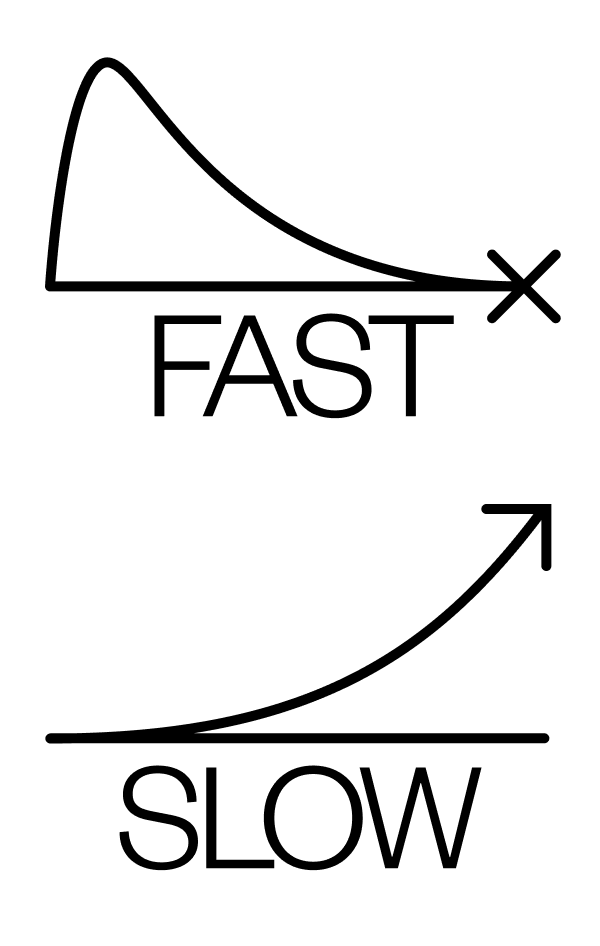
Having played it both ways now, I’ve come to love the value of slow success. Although, what I didn’t expect were its secondary benefits. Slow success is much more sustainable and resilient to shifting trends, and I find, it’s a much more fulfilling kind of success because every inch feels earned.
I'm sure there are many out there doing far better, so I hesitantly write this not to boast, but simply because I (embarrassingly) never even knew slow success was even an option in our industry. You won’t see slow success builders on podcasts or blow up in your feeds. They don’t make the Forbes 30 under 30 or get the gong on TBPN. But I suspect it’s the path that a lot more people would find a lot more success in. Really, slow success should become the new default script. I used to idolize fast growth companies. Now I admire slow builders like Panic, 37signals, and James Thompson who's maintained and shaped an app for 30+ year (new life goal).
Or course, the real prize isn’t the success at all. It’s mostly there to get you to something deeper. Slow success means you get to stick with an idea long enough for it to get interesting. Interesting work takes time. Many artists spend their entire life exploring a single technique or topic. Deeper work leads you to deeper meaning leads you to deeper fulfillment.
If you want to do your life’s work, do it slow.
What’s next?
If you're fortunate to find success in your effort, people will ask you, “What’s next?” And hiding behind the question is a hope in some larger vision or ambition you’re building toward.
So what’s our bigger vision?
We don’t have one. We have no plan to raise money or expand our audience or grow our team. I’ve been there, done that. It’s not better. It’s just different. Most of the founders I know were happiest in their early days when it was just them and a buddy building cool shit around a kitchen table.
We’re still the same 2-man team when we started. Mark and I have our hands in everything we make from the tiniest icon to the shirts that Marques Brownlee wears. I won’t romanticize it. It’s not always exciting work. Some of it is painfully boring. But, I love it. It’s been the most fulfilling work I’ve done thus far. It’s our default to wander, but with a bit of experience, you get better at recognizing when you’re right where you want to be.
So what's next? More of the same (interesting) stuff we've been doing.
Our deepest thanks to all of you for supporting our quest over these past 5 incredible years. Onward, ho!